Drlogy
Healthcare organization
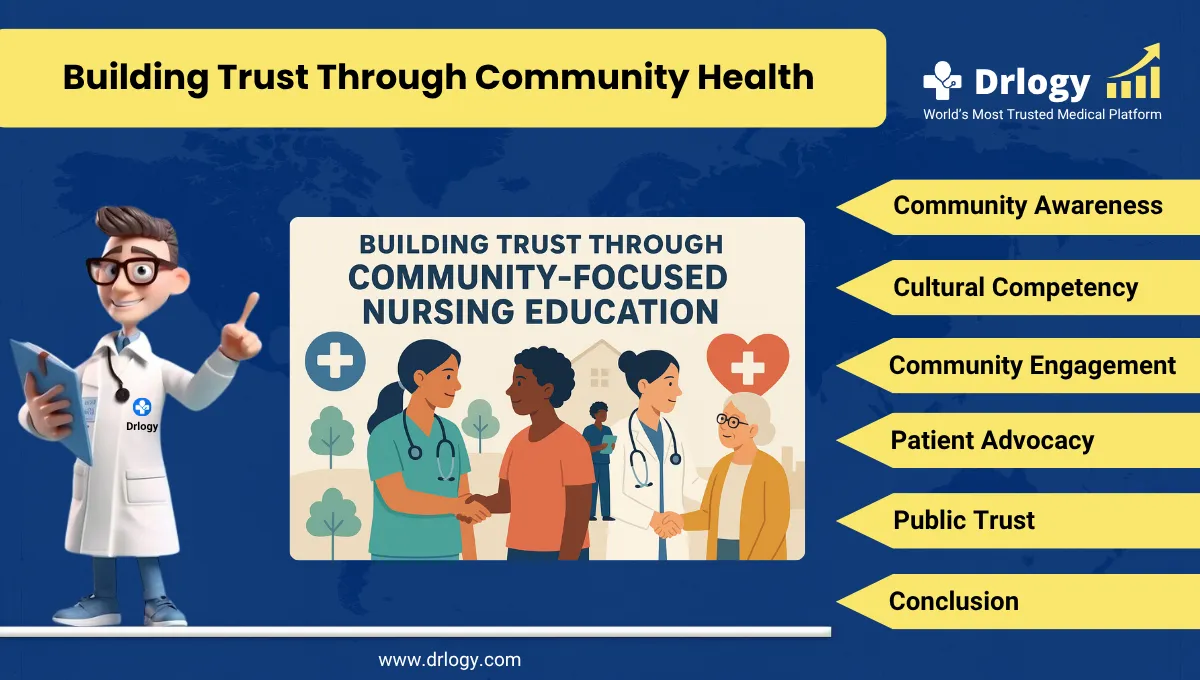
Building Trust Through Community Health
Trust has always been the heartbeat of nursing. It’s what allows patients to feel safe, understood, and supported during their most vulnerable moments. Yet, in today’s complex healthcare environment-where social disparities, misinformation, and systemic inequities continue to challenge public confidence-trust cannot be taken for granted.
For the nursing profession, this means looking beyond the hospital walls. It means expanding the definition of care to include the communities where people live, work, and grow. And for nursing schools, it means evolving the curriculum to ensure that the next generation of nurses is not onlyclinically competent, but also culturally sensitive, community-minded, and ready to buildrelationships based on understanding and respect.
From Clinical Skills to Community Awareness
Historically, nursing education has emphasized evidence-based clinical practice: mastering technical skills, understanding pharmacology, and following established care protocols. These remain essential foundations. However, healthcare is no longer confined to acute treatment; it’s about prevention, education, and long-term community wellbeing.
Nurses are increasingly at the forefront of public health initiatives—from leading vaccination drives and promoting mental health awareness to supporting chronic disease management in under-served areas. Such experiences reveal an important truth: clinical expertise alone isn’t enough. To make a sustainable impact, nurses must also know how to engage communities, listen to their concerns, and earn their trust.
When students participate in outreach or service-learning projects, they gain insights that no textbook can offer. They observe how socioeconomic factors, culture, and local infrastructure influence health outcomes. They see that health is not simply a biological condition, but a social one. And, most importantly, they learn that trust is built slowly, through empathy, consistency, and presence.
Cultural Competency: A Core Competency
Cultural competency - once considered a supplementary topic - is now essential to effective nursing. It’s not limited to understanding language barriers or dietary preferences; it involves grasping the deeper cultural values, historical experiences, and systemic inequalities that shape how people interact with healthcare systems.
A nurse who recognizes that mistrust of medical institutions may stem from generations of exclusion or neglect will approach care differently. This awareness leads to communication that is more open, more human, and ultimately, more healing.
To teach this effectively, nursing programs need to move beyond theoretical courses. Embedding students in real community contexts-urban neighborhoods, rural clinics, migrant health centers, elder care homes-creates opportunities for experiential learning. Through these experiences, students witness diversity not as a concept, but as a living, breathing reality of healthcare delivery.
This mindset aligns closely with broader health initiatives such as Novartis’ “Giving Back” program, which focuses on empowering local communities and healthcare providers to collaborate toward sustainable solutions. When global institutions and educational programs share this community-centric perspective, the results extend far beyond individual patient outcomes-they help rebuild public trust in the healthcare system itself.
Reimagining Nursing Curricula for Community Engagement
Integrating community health principles into nursing curricula requires both structural and cultural change within institutions. It’s not merely about adding a new module; it’s about rethinking the educational journey to include hands-on, socially grounded experiences that connect theory with practice.
Here are several strategies nursing schools can adopt:
1. Service-Learning Integration
Linkroom instruction with community engagement projects. For example, a public health course could include fieldwork in a local immunization campaign, allowing students to apply their learning while understanding real-world challenges.
2. Interdisciplinary Collaboration
Encourage partnerships across departments such as sociology, psychology, and public policy. Healthcare doesn’t exist in isolation, and neither should nursing education. Students exposed to cross-disciplinary collaboration learn to approach health from multiple perspectives.
3. Community Partnerships
Establish long-term collaborations with community organizations, NGOs, and local clinics. These relationships give students consistent access to populations who can benefit from preventive education, screenings, and wellness programs.
4. Outcome-Based Evaluation
Measure success not only through clinical proficiency but also through communication, empathy, and advocacy. Qualitative assessments-like reflective journals or peer evaluations-can capture growth in these softer, but vital, skills.
5. Digital Literacy and Health Equity
As healthcare becomes increasingly digital, students should learn to navigate telehealth tools, data ethics, and online health communication responsibly. These skills are essential for bridging the digital divide and maintaining trust in a tech-driven world.
By aligning educational practices with community engagement, nursing programs can produce professionals who are as comfortable in a neighborhood health fair as they are in an intensive care unit.
Patient Advocacy: Where Trust Becomes Action
Patient advocacy is one of the most powerful expressions of trust in nursing. It involves standing up for patients’ rights, ensuring access to care, and giving voice to those who are often unheard. Advocacy starts early—during training-when students are encouraged to question existing structures,entify barriers, and propose creative solutions.
Incorporating advocacy training into nursing education cultivates a mindset of accountability and leadership. Students who experience firsthand the realities of health inequities are more likely to champion change, both within healthcare systems and in policy discussions.
For example, when students engage with communities experiencing high rates of chronic disease or limited access to preventive care, they gain a deeper understanding of social determinants of health-income, housing, education, environment-and how these factors can limit or empower healthy living. By learning to advocate for systemic solutions, they transform compassion into measurable impact.
The Intersection of Technology, Trust, and Human Connection
As artificial intelligence and digital tools become more integrated into healthcare, the risk of losing the human connection grows. Yet, these technologies also present an opportunity to enhance community health if used wisely.
Nurses trained in both digital literacy and empathy can act as translators between technology and humanity. They can ensure that telehealth consultations remain personal, that digital records respect patient privacy, and that insights are used to reduce-not reinforce-health inequities.
Teaching students to approach innovation ethically helps future nurses balance efficiency with compassion. It reminds them that every algorithm or app ultimately serves a human purpose-to improve lives, not replace human care.
Building Institutional Responsibility and Public Trust
Beyond theroom, nursing schools themselves play a critical in modeling institutional responsibility. Transparency in partnerships, diversity in faculty and leadership, and accountability in community engagement all contribute to the credibility of an educational institution.
When nursing schools position themselves as active contributors to local and global health, they send a powerful message: education is not separate from society-it’s part of its healing process.
By participating in community health research, supporting volunteer clinics, or organizing outreach programs, institutions demonstrate the same trust-building principles they teach their students.
A Future Rooted in Empathy
The future of nursing will depend not only on technological innovation or clinical excellence, but on the ability to create and sustain trust. Every patient interaction, every community initiative, and every educational experience can either strengthen or weaken that bond.
By weaving community health, cultural competency, and patient advocacy into the fabric of nursing education, we can prepare professionals who understand that trust is both the foundation and the future of healthcare.
In this vision, nurses are not only caregivers-they are connectors, educators, and advocates who carry the values of empathy and integrity wherever they go. And as programs like Novartis’ “Giving Back” remind us, when healthcare engages communities with genuine collaboration, everyone benefits-from individual patients to entire populations.
Conclusion
Building trust through community health isn’t a trend-it’s a return to nursing’s deepest roots. The profession was born out of service to others, shaped by compassion and driven by equity. As the healthcare system evolves, so must nursing education, ensuring that these timeless values continue to guide the next generation.
Inrooms, clinics, and communities around the world, the nurses of tomorrow are already learning what the best educators have always known: true healing begins with trust.